


EPPARG Panel discusses Market Opportunities, Regulation and Innovation at 2026 Later Life Lending Summit: Leaders’ Symposium
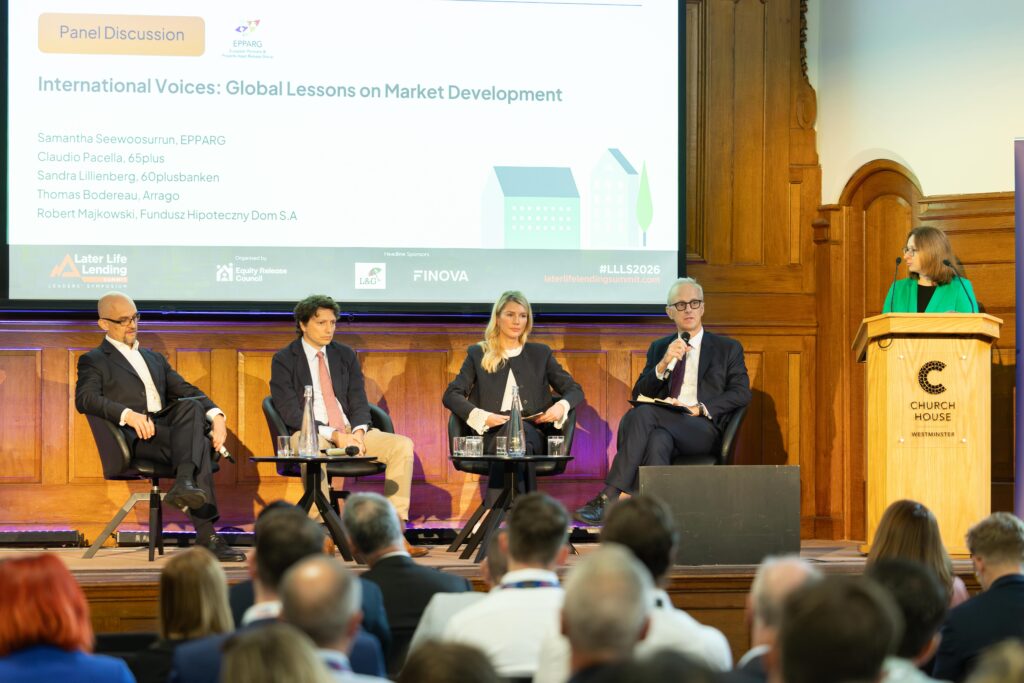
At the 2026 Later Life Lending Summit: Leaders’ Symposium, held at Church House, Westminster on 16 June, EPPARG hosted a panel of leading European industry practitioners to explore global lessons in market development, focusing on how to unlock the untapped potential of equity release, and drawing on the findings from its most recent Global Equity Release Survey.
The panel session was chaired by Samantha Seewoosurrun, Head of Secretariat for EPPARG, who introduced the panellists Claudio Pacella, CEO of 65Plus; Sandra Lillienberg, Head of Operations, Enity Bank Group (including 60plusbanken); Thomas Bodereau, CFO and Co-Founder of Arrago; and Robert Majkowski, CEO of Fundusz Hipoteczny Dom SA.
Defining the conditions to unlock market potential
Setting the scene for the discussion, Samantha Seewoosurrun asked Claudio Pacella what conditions were needed to unlock market potential, which would allow equity release to thrive.
Claudio Pacella explained that although equity release is becoming more mainstream in the UK through the media and the news, “taking out equity release mortgages outside the UK remains much harder.” In order to rectify this trend, he stated that EPPARG as a collective has been setting up and abiding by more standards. “The moment we are able to say that our products are basically the same, fulfil the same needs of our clients, as well as fulfilling the needs of the funders, everything becomes much easier.”
He noted that “continental Europe has a large market of seniors that need to be funded”, indicating that the market potential is definitely there, but several countries experienced hurdles in obtaining the adequate regulation or the proper funding.
Taking Italy as an example, notwithstanding a clear huge potential and a complete and proven regulation, the lack of funding has prevented the full development of the market. But to unlock funding and following market volumes, there is still a chicken-and-egg scenario: “you cannot ramp-up a €300 million portfolio without a warehousing facility”, while major investors only have an appetite to look at large and back-books. He noted that Italy is “currently getting the funding”, noting that “closing the funding gap” is difficult for many countries.
He also added that “European origination will help to enhance securitisation. If we are able to start global securitisation portfolios, and also European portfolios, this will help the securitisation industry of ERMs across the globe.”
The role of innovation in driving a positive product and client experience
Sandra Lillienberg highlighted equity release as a strong example of how AI can improve both product and customer experience. Accepting that equity release is often perceived as a complex product, she outlined that AI can provide customers with instant answers to their queries or worries such as: “How much will my loan grow?” or “What will be left to my children?”
Sandra also noted that although “older people are targeted when it comes to financial crime, and AI is a tool that helps to make financial crime”, she believed that there could be a use for AI in protecting customers from this type of crime in the near future.
“When we look at this Global Survey, we can see that Sweden is a very small market compared to the UK and the US, but AI is important for all the markets,” giving the example of adopting digital signatures for promissory notes as one way in which innovation has already been leveraged.
She also emphasised the importance of customer trust in equity release products, and mentioned that 60plusbanken have been addressing the topic of trust through talking about ageism. “It’s in the labour market. It starts from like 45 to 50. It’s more challenging to get a job. Financial inclusion is a huge problem.”
To combat this prevalent ageism, 60plusbanken had launched an award and gala, named Most Promising After 60, as an initiative to “celebrate people over 60 who are still driving innovation, entrepreneurship and inspiring change in society.”
“Our role is not just to provide a financial product, but to support the same mindset, enabling people to stay active, make choices and live the life they want on their own terms,” Sandra concluded.
Harnessing opportunities for growth and sourcing funding
Offering a perspective from France, Thomas Bodereau began by discussing viager transactions. “A viager is a home reversion scheme which is very popular in France, but barely anyone understands how it works,” adding that only around half of people of an age suitable for a lifetime mortgage in France are aware of viagers.
“This has been a business that has not really been scaling for decades, for the simple reason that the funding is over the counter.” He continued: “If you want to sell your home in a viager transaction, you need to find someone to buy it. Obviously, you will understand quickly that it is very difficult to find, at the corner of the street, someone who wants to buy the house of an old lady and wait for her to die to get it.”
This sentiment was what made Arrago “realise very quickly that there was a missing lifetime mortgage market in France a couple of years ago.” Thomas continued: “We had a chance, but the big retail banking groups in France were not so interested in it, for the simple reason that it was so different from what they were doing on a day-to-day basis, which was cash flows of consumer loans, real estate loans, all amortising. And this one was capitalising, so it was completely out of their mindset.”
Having decided to seize this opportunity, they encountered challenges trying to source funding, because they “could not convince French institutions, as they were not really aware of this product, and the institutions don’t like to take risks.” Thomas added that the company was eventually able to secure the first €50 million from French lenders.
These institutions became more supportive after the company moved towards “private equity funds, based in London for this business,” and the flow funding they were subsequently granted led to competition. “Retail banking groups in France are thinking about it, which is already a start.”
Thomas outlined that this competition is consequently leading to growth in the French market. “The potential in France is huge. The real estate market is very steady, so there is not much risk around property.” He stated that Arrago is currently prioritising creating more awareness of the product.
“Overall, if you compare it to Ireland, Sweden or the UK, which are much more mature markets, there should be, at some point, a €1.5 billion to €2.5 billion potential market. And we are paving the way to make it happen,” he concluded.
Striking the right balance on regulation
Sharing his experience as a home equity release provider from Poland, Robert Majkowski first explained how little regulation exists in the Polish equity release market, and “after years of growth in such a strange market, it created crimes at an extremely high level.” Learning from how equity release products were regulated and offered in the UK 18 years ago, Robert’s company Fundusz Hipoteczny Dom SA sought to replicate something similar in Poland, but found that “offering a lifetime mortgage in Poland was, in practice, impossible.”
He stated that only home reversion was possible, but only “on the basis of the Civil Code, without any capital requirements, any know-how requirements, any dedicated sector-specific protection, any checking of the reliability of the provider, or any conduct rules that you have to keep in order to protect the client,” which evidently would have left consumers at risk. “The market started to grow, but this appeared to be a market that was not a professional one,” Robert added.
Having “created a code of conduct based on the SHIP standards in those days,” the company engaged with policymakers and advocated for legislation “which would allow professional services for home reversion and lifetime mortgages.” After a lengthy legislative process, Poland introduced legislation in 2014, but it only regulated lifetime mortgages, leaving home reversion entirely unregulated still.
Robert described a puzzling situation where: “We have very good regulation for lifetime mortgages, which can be offered only by licensed, supervised entities such as banks, and the product does not exist at all. But we have another market where the product is available, but it is completely unregulated.” He therefore emphasised the importance of regulation being balanced, as to prevent the emergence of predicaments such as the one he described.
“It has to be evolution and not revolution. If anyone is making a revolution, there is a high risk of going the wrong way. If there is evolution behind that, usually you can adapt to the situation. We can learn from each other how to adapt, how to develop, and that’s what we are trying to do in Poland,” Robert outlined.
On a positive note, he revealed that “over the past year, we have seen much stronger engagement from the Polish authorities in the process of regulating the whole market, including home reversion,” and warned the same experience could happen in other countries if the correct balance is not found in terms of regulation. “We should talk with decision-makers across Europe about how to support the development of this solution, because simply it will help society across Europe.”
Robert summed up his remarks by highlighting that more pensioners across Europe becoming asset-rich but income-poor is presently leading to higher demand for equity release products, which in itself makes it all the more important for decision-makers to get regulation right.
After Claudio reiterated the importance of European equity release markets collaborating to support securitisation, Samantha Seewoosurrun concluded the panel by thanking the speakers and the audience who had attended EPPARG’s session, and reminded guests to visit their website for further information on the topics discussed.