
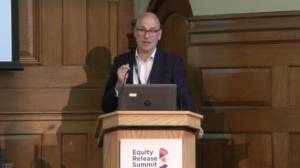

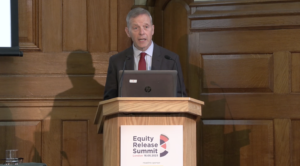






The UK’s Equity Release Summit, hosted by the UK Equity Release Council, kicked off its 2023 edition at Church House in Westminster on 16 May. The Summit brought together industry leaders from the UK and beyond, with participants including EPPARG members from across Europe as well as representatives from the US, Canada, Australia and South Africa.
The Summit was composed of a series of plenary sessions and industry breakout sessions covering a wide range of topics facing the equity release industry, such as green equity release, later life lending, understanding ageing consumers and their needs, mitigation of green risk and the role of automated pricing among others.
Opening the Summit, David Burrowes, Chairman of the UK’s Equity Release Council (ERC), welcomed guests not only from the UK from a range of countries including Australia, Spain, the US, France, Sweden, the Netherlands, Poland, Ireland, Italy, Germany, Norway, Canada and South Africa.
Equity release is a key tool in the box for later life financial planners
Commenting on the reason why the Summit is attracting interest, David Burrowes pointed to the “growing realisation that equity release is a key tool in the box for later life financial planners and also policy makers grappling with the big questions being asked.” He saw that the key questions were: “How do we help people to live well in later life? How do we support older consumers’ choice, flexibility, security and dignity?”
He highlighted that equity release is an important part of the answer, since “the UK’s ageing population needs to safely access property wealth to make better later life living standards a reality”. He noted that since 1991, when the ERC’s standards were launched by its predecessor, 640,000 older people had accessed £45 billion pounds in property wealth to become more financially secure, meeting their families’ needs and aspirations. He also recalled the wider benefits for the economy, “not least with 80,000 jobs, and for every pound of ER £2.12 in gross value is supported across the UK economy”.
“Since the last Summit we have continued, as a Council, with your support, to build a modern equity release sector with robust standards at its heart that are fit for purpose. In the last decade we have grown from less than £1 billion to last year lending more than £6 bn,” he added.
He also noted that the ERC had introduced a new product safeguard that enables all new customers to make penalty-free overpayments, which was “so important in a high rate environment”, and was supporting members in complying with the consumer duty. He emphasised that the Council was looking at where they wanted to be in the next 30 or so years, so the later life lending market can reach its own potential. Overall, he saw that the industry had gathered for the Summit as they were genuinely committed to transforming older customers’ lives.
Property wealth in equity has the ability to support many massive challenges facing the UK
Matt McGill, Equity Release Director at Aviva, highlighted that Aviva has been active in equity release for 25 years, and has helped more than 280,000 customers release £10.8 bn of equity from £48 bn of housing wealth. He noted that the industry has got challenges since equity release has a poor perception amongst many. He stated that he reviews complaints each week and saw that “the number of children as customers that refuse to believe their parents took out a product shows how far we still have to go”.

He underlined that public understanding of what equity release is, why and when you should take it out, “isn’t where we want it to be”. He also noted that there had been a 54% drop in lending in Q1 which meant that customers are unable to get the rates and LTVs they require. He saw that this led to a strain on business models, with funders making a “quick shift” to alternative assets. He saw that the public and industry were “eagerly waiting the return of stability in the global and UK economies”.
On the plus side, he saw that customer needs still exist, since the state pension was only providing a basic level of income, and that almost 1 in 5 of those aged 55+ have less than £1000 in savings. He asserted that “property wealth in equity has the ability to support many massive challenges facing the UK”, whether in terms of retirement income, social care, supporting the next generation or environmental upgrades. He concluded that the industry should be optimistic about the future, since equity release has a purpose, and that the industry had “an opportunity and responsibility to rise and meet this purpose”. He stated that Aviva was committed to playing its part and thanked the Equity Release Council for its leadership in the industry.

Government should engage with business and work with the industry
Matt Rodda MP, Labour MP and Shadow Minister for Pensions, commented that his party saw that it was very important to work with the pensions industry and wider financial services industry since “the country faces an unprecedented cost of living crisis and a period of very low growth”.
As a potential future government, he emphasised that for his party it was “very important that we engage with business and work in partnership with business”. He noted that the party was now going through a policy review process and he asked people to raise issues with him to take them back to shadow ministers who cover equity release.

He recalled that pensions had undergone quite a considerable change in recent years, with defined benefit replaced by defined contribution schemes, with many people now having access to workplace pensions for the first time. He noted that the current government had introduced some pensions freedoms that they recognised, and also referred to mid-life MOTs. He said they had been calling on the government to do more to help pensioners and also to ensure better administration of the state pension. In terms of the future horizon, he also pointed to the need for greater green investments and the need to avoid scams. He thought it was important for government to engage with business and work with the industry, so people should be able to look forward to a decent retirement. Above all, he thought that as a potential government it was very important for them to discuss with the industry.
On 15 May, on the eve of the UK’s Equity Release Summit, EPPARG hosted a dinner at the Royal Air Force Club in London, bringing together members from across Europe, as well as members of the Global Equity Release Roundtable from the USA and Australia to discuss topics affecting the global equity release industry. The Rt. Hon David Gauke was the guest speaker on this occasion.
The European Pensions and Property Asset Release Group (EPPARG) is pleased to announce that ARRAGO has joined EPPARG as its latest new member from France.
ARRAGO is a French lifetime mortgage provider based in Paris. The company serves borrowers aged over 60 across France, and it is on track to achieve its first €50m of mortgages.
ARRAGO offers a lump-sum lifetime mortgage with compound interest up to the total value of the property. By raising debt, elderly homeowners can enhance their way of living and finance their projects. This solution is under-developed in France, where the market has been traditionally served by home reversion providers but with much less flexibility and a limited offer to few local markets.
Speaking on behalf of EPPARG, Steve Kyle, Secretary General, said:
“We are delighted to welcome ARRAGO on board as our latest new member from France, and to see a real resurgence of interest in equity release in the country. We have noted a number of new market entrants starting business over the past year across both lifetime mortgages, which ARRAGO is offering, as well as in home reversions. We are encouraged to see these developments as providing real choice to elderly homeowners in France, who have had limited options to draw down the equity from their home for far too long.”
“ARRAGO are fully committed to the EPPARG 10 standards which we have developed to ensure business ethics and consumer protection, and we look forward to working with them as we seek to safely grow and strengthen the European equity release market”.
Commenting on behalf of ARRAGO, Alexis Rouëssé, Co-Founder, said:
“France is a market with very high potential for development ahead. The combination of ageing demographics, inadequate pension provision and limited financing of mass market solutions for the elderly makes our lifetime mortgage offer very interesting. By joining EPPARG our ambition is to achieve best practice and contribute to developing equity release solution in helping the elderly population to better manage their wealth efficiently.”
EPPARG is the principal trade body representing the interests of home equity release providers in Europe. Countries with EPPARG representatives or associates make up over 75% of all the countries in Europe with a home equity release market.
Robert Majkowski, CEO and Co-Founder of Fundusz Hipoteczny DOM S.A. which is the pioneer and largest home reversion provider in Poland, shares his views on prospects for equity release for the year ahead.
In 2023, financing for entities offering Equity Release in the European Union will take off. This will be achieved, firstly, through access to long-term and tailored funding for equity release providers in the European Union. Secondly, there will be a better and more diverse portfolio of equity release solutions. Thirdly, the possibility of higher one-off, lump-sum payments will help the elderly pay off liabilities and debts – including those that arose due to the pandemic, the war in Ukraine, and rampant inflation. Fourthly, there will be greater cooperation between European countries, not only in the field of education but also in terms of financial security of pensioners. Fifthly, it will provide support for the younger generation, even though the equity release is aimed at the elderly. So what changes will take place in the Polish and European markets in 2023? The most important of these changes are highlighted below.
Demographic and economic prooblems are being faced not only in Poland but across Europe. Equity release has already become the answer to some of them. What will happen in 2023?
Long-term funding and a better offer
In 2023, a new platform which aims to fund the subsequent and long-term development of the equity release market in the European Union will start operating. Service providers will have access to long-term, tailored financing, leading to an improved offer to be addressed to customers. Fundusz Hipoteczny DOM will be responsible for developing the equity release market under this project in Poland.
It is worth quoting data from a report prepared by Ernst & Young (EY) and the European Pensions and Property Asset Release Group (EPPARG). According to EY and EPPARG forecasts, the global equity release market is predicted to grow threefold by 2031. In 10 years, the annual volume in the United States will exceed USD 25 billion, which means that Americans will sell (in one year only) equity release of this value. In Great Britain, this volume will amount to USD 13 billion a year; in Italy USD 6-10 billion; in Canada USD 3-4 billion; and in Poland about USD 0.6 billion[1]. The platform will start operating in 2023, only accelerating this development.
It is worth emphasizing that the financing being discussed is based on the British model. Thanks to the funding, the industry in the UK has been developing safely and dynamically. The UK market is already mature and regulated, with existing ethical standards. Moreover, the service is well regarded by consumers, as well as decision-makers, politicians and economists. Its positive impact, not only on the situation of people of retirement age but also on the entire economy, is appreciated. This success in the British market is reflected by the number of new clients, which in the previous year reached almost 50,000. British solutions are certainly worth transplanting to other markets, and this is what is happening.
Larger lump-sum payments
Thanks to access to long-term financing, home reversion – one of the types of equity release – will develop more dynamically, and the offer will become more diverse. At the beginning of the year, we intend to introduce, among other things, larger one-off payments. This is a solution that we have been testing for some time, and it is a response to the needs of the elderly. In Poland, the lack of funding limited the level of one-off payments. Inflation and rising prices have strained pensioners’ budgets drastically. It has become even more costly to heat and maintain unrenovated properties. Retirees often need a cash injection already at the contract date. Later, of course, they receive standard monthly payments. It should be noted that current pensioners, meaning people aged 60+, who took out mortgage loans for the purchase of real estate years ago, are currently in the final stage of their repayment. One-off payments can help them pay off the remaining part of the mortgage, especially since rising interest rates have increased loan instalments.
Greater cooperation between European countries
The changing demographic and economic situation and the dynamic development of the equity release market across Europe will strengthen cooperation between European countries. Among other topics, long-term education of the elderly will be needed to guarantee them complete and reliable knowledge about the service and regulations. This is vital, not only in the context of equity release, but also other financial instruments that could improve the economic situation of pensioners.
Financial support for young people
The macroeconomic situation has led to a rapid decline in the creditworthiness of young people. In September 2022 in Poland, the number of housing loans fell by 70.6 per cent, compared to the previous year, while their value was 71.3 per cent lower than a year ago [2]. In addition, according to the report of the National Bank of Poland entitled “Situation on the credit market” in the fourth quarter, banks were expected to continue to tighten their lending policy relating to entrepreneurs and households [3]. Seniors who own real estate and decide to proceed with a home reversion will be able to support their children and grandchildren financially, as well as contribute to the purchase of a flat for young people, thanks to a larger one-off payment.
***
[1] Report “Global Equity Release Roundtable 2020”, prepared by EY and EPPARG, published on January 28, 2021.
Link: https://epparg.org/news/global-equity-release-market-forecast-to-more-than-treble-by-2031/
[2] https://www.pb.pl/we-wrzesniu-liczba-creditow-mieszkaniowych-spadla-o-706-proc-1167723
[3] https://www.pb.pl/nbp-w-iv-kw-dalsze-zastrzenie-polityki-kretowej-wobec-firm-i-gospodarstw-domowych-1168715
Almost four out of every 10 older people in Ireland are having to make signifcant financial cutbacks in their standard of living to make ends meet.
That’s the findings of Behaviour and Attitudes research from Spry Finance – the sole provider of lifetime loans in the Irish market.
Of 301 homeowners in Dublin and other urban areas aged over-60, 32% said they were having to make significant cutbacks to make ends meet, 6% described themselves as ‘stretched’ and having to make very significant cutbacks, and 1% said they were financially ‘stressed’ because they couldn’t make ends meet and were having to cutback on essentials.
Just 17% of respondents said they were ‘very comfortable’ financially and able to afford everything they needed, with 44% stating they were ‘quite comfortable’ and were getting by but making a few minor cutbacks.
The research also found that 30% of over-60s considered themselves either quite or very unprepared for the financial demands of later life, with 70% stating they were quite and well prepared.
The release of the research findings comes as Spry Finance launches a new campaign to raise awareness of its Lifetime Loan equity release product.
The advertising tells the story of Jimmy and Elaine, from when they first lock eyes across a crowded 1970s dance floor, through marriage, children and into later life. The years have passed but Jimmy and Elaine’s love and sense of adventure still burn bright, and they are excited about what comes next. It ends with the tagline: ‘Because life never gets old’.
Ailish McGlew, Head of Marketing and Communications at Spry Finance, said: “Many people who are over-60 still feel young and are excited living life to the full – but they tend to be poorly served by lenders when it comes to accessing credit or realising value from their assets such as their home, in order to afford the things they want to do.
“As a result, we see that one out of every four older people is making significant cutbacks in their standard of living. We don’t think they should have to compromise – be it on essentials or living a greater life in later life – and our new campaign is about providing choice for them.”
The new campaign – launched on 2 January across TV, radio, print and digital – comes two years after Spry Finance launched as the retail brand of Seniors Money. During the last 12 months, the company has entered into a €100m long-term funding arrangement with Canada Life to re-finance its existing loan book and provide funding for future lending, and set a target of growing the Irish Lifetime Loan market to €150m over the next two years.
The European Pensions and Property Asset Release Group (EPPARG) is pleased to announce that Dillan has joined EPPARG as its latest new member from France.
Dillan is a home reversion company founded in France in 2020, which has the goal of improving the financial situation of seniors in France, beyond the historically small existing market.
In launching Dillan, the founders have embarked on a journey to propose its offering to senior customers, while the general public and institutional investors can also invest in this attractive sub-segment of the residential market for seniors, to prepare their retirement while improving that of others.
Speaking on behalf of EPPARG, Steve Kyle, Secretary General, commented:
“We congratulate the team at Dillan on their efforts to reinvigorate the French home reversion market, which we believe has the potential to grow significantly over the next few years. We believe that this will provide greater choice to elderly homeowners seeking an innovative financing solution which meets their needs, and we are pleased to welcome Dillan on board as our latest French member.”
“We also appreciate that Dillan is committed to working with EPPARG to ensure high ethical and consumer protection standards and to abiding by our own EPPARG standards, which have an important role to play in ensuring the development of safe equity release market across Europe.”
Commenting on behalf of Dillan, Stéphane Revault, Co-Founder, said:
“We are honoured to join EPPARG. Our mission is to provide home-based financing to seniors with transparency and simplicity. Joining EPPARG will allow us to seek the highest standards on the market while growing. We are happy to play our part in the development of a structured and consumer protective market aligned with our values.”
EPPARG is the principal trade body representing the interests of home equity release providers in Europe. Countries with EPPARG representatives or associates make up over 75% of all the countries in Europe with a home equity release market.
The European Pensions and Property Asset Release Group (EPPARG) is pleased to announce that Jubilé from France has joined EPPARG as a member.
Jubilé is a young French start-up created in 2021. As a ‘mission-driven company’, Jubilé’s objective is to give people over 60 access to a fair and ethical financing solution: the Jubilé Loan. This type of loan for senior citizens is backed by property that the borrowers own and provides a new source of financing with a deferred repayment upon the death of the borrower.
With the Jubilé Loan, people over 60 can obtain a new way of financing their retirement by accessing some of the money linked to the value of their property. This allows them to withdraw money from the value of their home, without having to move, and thus to finance their major needs: financing dependency, adapting the home and staying at home, energy renovation and intergenerational aid, among others.
Convinced that seniors still have a role to play, Jubilé gives them the financial means to carry out their projects, with a fair and ingenious loan that makes retirement a new horizon where everyone finds the power to act and the pleasure to choose how to grow old.
Speaking on behalf of EPPARG, Steve Kyle, Secretary General, commented:
“It is a pleasure to welcome Jubilé on board as a member of EPPARG. This points to a rebound in the lifetime mortgages market in France, which has been dormant in recent years, and we are encouraged by the renewed interest in the market. We anticipate that there is room for more new players to enter the French market given the country’s ageing demographics and we look forward to seeing the emergence of a number of new solutions across the market.”
“We look forward to working closely with Jubilé and we welcome the company’s commitment to comply with EPPARG’s standards, which focus on ensuring a high level of business ethics and consumer protection, as the business develops and grows.”
Commenting on behalf of Jubilé, Mikael Levy, Co-Founder, said:
“Nowadays, in France, over-60s don’t have any financing solution even though over 70% of them are homeowners. Moreover, no fair and ethical solution is proposed to our parents. Yet they have huge financing needs! Whether it is for home improvement and adaptation, home maintenance, ageing well, the cost of dependency, or intergenerational aid, or even just for pleasure, access to credit is a major issue. Aware of the urgency, particularly in France where no one distributes such a solution, our membership of EPPARG is essential to enrich our project and allow us to develop our offer in an ethical and fair manner, in respect with EPPARG’s standards.”
EPPARG is the principal trade body representing the interests of home equity release providers in Europe. Countries with EPPARG representatives or associates make up over 75% of all the countries in Europe with a home equity release market.
The Equity Release Summit was held on 12 May 2022, as the UK’s annual landmark event bringing together leading players from the UK, European and international equity release industry, with the first plenary session of the day held on the theme of green equity release.
Opening the Summit, David Burrowes, Chairman of the UK’s Equity Release Council, noted that the event brought together industry professionals from around the world, including from the USA, Sweden, Spain and The Netherlands, among others. He recalled that the last event two years ago had been held on the cusp of a national lockdown, and that now the industry was again able to come together to network and to take part in discussions, noting that it had been very much “on the front foot” in bringing solutions.
David highlighted that “property wealth is key to enriching the lives of so many people in this country, whether for a more comfortable retirement, green equity release, to help younger members of the family get on the property ladder, or to pay for a higher standard of later life social care”. He noted that there are a myriad of other uses, including “simply giving happiness in later life. If wealth is unlocked safely, using all the safeguards of the standards that we are rightly proud of, equity release can transform the lives of so many people”.
Coming to the last two years, David recalled that “as an industry, we have not gone into hiding but during lockdown we were able to remain operational, and since then we have grown and evolved”. He mentioned that carrying out valuations during the lockdown had been a challenge, in view of the use of predominantly face to face financial advice and the mandatory requirement for in-person legal advice. He recalled that the Council had quickly brought together the funders, providers, distributors and solicitors and others to temporarily enable this. Overall, he saw that “the industry showed real resilience during this time and it prompted more flexible ways of working”.

Bernie Hickman, CEO of Legal & General Retail, as the main sponsor of the event, spoke of the “unashamedly positive case for the good that equity release achieves for customers and society”. He highlighted that “L&G is a big believer in the importance of businesses like ours in playing a prominent role in addressing the big challenges facing society. Being socially useful doesn’t mean being less profitable, in fact it helps sustain profits over the long term as we become more relevant to our customers and inspire people with our purpose and our social values. We are passionate about addressing the biggest challenges of our generation, the biggest ones being tackling climate chance and the more immediate challenges of the housing affordability crisis and, looming large, the cost of living crisis, which is why we are such big supporters of equity release through later life lending. We can see that, with good advice and family involvement, equity release can play an important role in addressing all these challenges while also helping to boost economic growth in the UK”.
He underlined that, as compared to passing on property to heirs, “a lifetime mortgage can achieve a much better outcome as a way to provide a legacy while alive, much earlier and at a much more useful time”, and that the giver would then have “a chance to see the outcome of a life-changing gift”.
He emphasised that “equity release isn’t right for everyone but where it is appropriate and accompanied by high quality advice it transforms lives and brings dignity, security and greater enjoyment in retirement”. He noted that those who do take out an equity release product are prepared to recommend it to others, with 90% in a survey saying they would do so. “With pension provision falling and the cost of living rising, more people will need to supplement their retirement finances with access to housing equity in the years to come,” he predicted.

Focus on Green Equity Release
The first plenary session was on the topic of Green Equity Release, which looked at the green deal and the role of housing wealth and equity release, retrofitting the ageing housing stock and the potential for equity release innovation.
Emma Harvey, Programme Director at the Green Finance Institute, warned that we are in the midst of a climate crisis and there was a need to act now. She saw that the commercial and corporate world was “making a move for the environmental agenda” and that the finance sector was one of the sectors at the forefront of this. She explained that she saw green finance from two perspectives, firstly “greening finance” which covered managing the risks associated with the transition to net zero, disclosure and taxonomies, for example, and secondly “financing green” which referred to mobilising capital to design and develop new financial products that generate revenues and lead to positive environmental outcomes.

She highlighted that buildings in the UK are responsible for 23% of emissions, and that most of these were from home, from heating and powering properties. She noted that the UK Climate Change Committee had estimated that £250 billion of investment would be needed to decarbonise homes, and that private investment is “absolutely necessary”. This is why the Green Finance Institute established the Coalition for the Energy Efficiency of Buildings at the end of 2019, she commented, to identify barriers to investment into decarbonising properties and how investment could help address those barriers.
Emma explained that green mortgages were currently the “poster child” of green home financing, with the number of products on the market now having reached “double digits” and some of these had adopted the Green Finance Institute’s green finance principles. She added that green equity release solutions were also coming to the market. In terms of the way forward, she saw that a range of solutions were needed, including data solutions, to gather momentum to share best practices, and that there needs to be collaboration and awareness raising with consumers.

Benet Northcote, co-founder of Intentio Finance, took the view that “every equity release product will need to become green very quickly if we are to avoid the worst effects of climate change”. He noted there was a lot of discussion about ESG and its importance but considered that this “will not drive change fast enough on its own”. He thought it was essential that financial institutions understand the impact that they have on the world and to look at the tools to make a real world impact.
With regard to the various schemes seen in recent years on retrofitting, solar panels and others, Benet saw that “they have all largely failed at scale”. He suggested that one of the questions that needs to be asked is “what is going to make the consumer want to do this and have the improvements made to their home?”
Steve Norris, Chairman at Soho Estate Limited, recalled that in the UK there was £5.2 trillion of real estate equity and that “it’s about your own costs”, anticipating that energy costs were likely to rise substantially in the next year or two. He considered that “there is something unique we can do with a product like equity release” and noted that some other countries like Italy were paying 110% of the costs of installing equipment such as solar panels. For those taking out equity release for green improvements, he noted that even on the basis of rolled up interest “the asset is worth more than if you had done nothing”.

Asked what a green lifetime mortgage could look like, Emma noted that that this could improve energy efficiency, leading to lower interest rates and cash back, as well as non-financial benefits such as free energy efficiency assessments, if part of the funds had gone to this or climate resilience improvements.
In terms of how green equity release mortgages could become the norm, Benet underlined that changes bring a lot of inconvenience, and so he saw that “the product has to be wrapped up in the impact on lifestyle”. He considered that many equity release customers may be under a degree of financial stress and were older than average, so needed to get over those barriers.

Looking ahead, Steve recommended dividing the market into new build and retrofit, where the rationale for the latter was taking a product that is no longer fit for purpose and making it one. On new build, he noted that ESG is now critical in housing markets. He summed up his view by saying “the closer you get to being energy self-sufficient the better it is for the consumer in the home. This will all be at the top of the agenda in terms of the attractiveness of the product and bringing it to market”.
Concluding the session, and in response to questions from the floor on the prospects for green solutions, Emma noted that “this challenge is incredibly complex. Finance is not going to solve it, technology is not going to solve it and policy is not going to solve it in and of itself. We need to have all these different pieces coming together and that is where collaborating across different sectors, working with normally your competitors, to help build this market is so critical. Finance is not going to solve the problem but, when that demand comes through, we need to have the products ready so they are not a blocker to solving this challenge”.
A link to the Lender’s Handbook published by the Green Finance Institute/CEEB last year is available here. The Handbook aims to inform lenders about different green home retrofit solutions and technologies by providing a profile of the options available and their associated opportunities and risks, as well as quality assurance standards.
Thor Sandvik, Founder and CEO at LittExtra AS in Norway, explains that in the light of state pension reform in the country, along with a shift in corporate pensions from defined benefit plans to defined contribution plans, equity release through a lifetime mortgage will be the only solution for many retirees in Norway.
What impact has state pension reform had on retirement income in Norway?
The state pension reform was approved by our parliament in 2011, but it has not had much impact on retirement income yet. The reform will cut the state’s pension obligations by around 20%, so it will have a very real negative effect. However, the cut in pension benefits is phased in starting with people born in 1953 and only people born in 1963 or later will experience the full negative effect of pension reform.
What is happening to corporate pensions?
Starting right before the year 2000 there has been a massive move from defined benefit plans to defined contribution plans. Defined benefit plans secured income for life. Defined contribution plans offer flexibility in how the retired person can draw down their pension capital. What is interesting and disturbing is the fact that most people take out all of their corporate pension capital over 10 years after turning 67 years old.
What about the pension entitlements from old defined benefit plans?
In Norway when a corporation decides to change its plan from defined benefit to defined contribution, the defined benefit plan is frozen and converted into a paid-up policy for life. This might sound like a possible cushion to retirement income, but due to technicalities in these contracts and the current low-interest rate environment there is consensus among experts that the promised nominal pension amounts will not be regulated, and that purchasing power will be lost every year. After 20-30 years we will see dramatic losses in purchasing power.
Where does this leave the Norwegian retirees?
Retirement income will drop. The effect will by delayed by the way state pension reform is gradually phased in, and also postponed by the unsustainable drawdown most people decide to do. After turning 77 years the harsh reality will surface. Not only will the state pension be less than before, the defined contribution plan will be empty, and the purchasing power of the old defined benefit plan will be eroded.
Is equity release in Norway an opportunity only for the patient?
Business is good today, but we expect it will only become better as the mentioned effects kick-in. It is important to be aware that most equity release in Norway is through traditional mortgages and home equity credit lines. When banks eventually start taking into consideration the outlook for future income of a retired person, the credit assessment will result in a red flag, and equity release through a lifetime mortgage will, for many, be the only solution.
Another important positive factor for future demand for equity release is house price development. The major cities have seen prices almost double over the last 10 years. With homeownership among 60 plus exceeding 80%, many people have most of their savings tied up in their home.
Sandra Lillienberg, Head of Equity Release at 60plusbanken in Sweden, shares her perspective on the prospects for growth of equity release in the Swedish market and the role of 60plusbanken within this, with a recent report showing that having a stable financial situation is the most important thing for an absolute majority of Swedes when retiring.
Tell us about 60plusbanken, a unit of Bluestep Bank AB (publ), based in Sweden. When was the company launched and what services does it offer?
That’s right, 60plusbanken is a part of Bluestep Bank, the leading specialist mortgage bank in the Nordics and we launched in June 2020. As of today we offer one product – 60pluslånet- an equity release product aimed at helping people over the age of 60 to free up capital tied in property to allow for more people to have a stable retirement without having to move.
60plusbanken recently published a report, based on a survey by Kantar Sifo, setting out the views of over 60s on their personal finances. Could you share some of the key findings of this report?
Yes, we released a report called the 60plusreport which is a survey that shows how Swedish people of all ages view their retirement, what they wish for and worry about. The most striking finding is that the absolute majority of Swedes say that the most important thing when retiring is having a stable financial situation. That means that most people don’t dream about expensive trips or luxury – but to be able to maintain the quality of life that you have built. In connection to this we also see that a majority worries about having a low income as a retiree. This proves that there is a large demand for our product.
How would you describe the evolution of the equity release market in Sweden and in Scandinavia more broadly?
Equity release has been a product offered by most large banks in Sweden before, however that product was heavily criticized and rightly so. 60pluslånet is a new type of product that offers a debt-free guarantee and a guarantee to be able to continue living in your house regardless if the market prices fall. This makes it much more secure and sustainable long term than the products that have existed before. The introduction of amortization requirements on mortgage loans and the income requirements for loans has left many retirees excluded from traditional banks. We have a big role to fill here, both for individuals and for society at large as well. Since the 60plusloan is free from amortization and the interest is not paid until the property is sold, we enable people who own their houses to gain from the increasing market prices by increasing their mortgages without increasing their monthly costs.
How has 60plusbanken been reaching out to potential customers? What sort of feedback have you received so far? Did you have to adapt your plans and practices in the light of the pandemic?
My experience is that when you get the chance to explain what the 60plusloan entails in more detail most people are very positive to this product. I think it is important to state that this product can change the life for many people and ensure a stable situation after a lifetime of working. The pandemic has of course affected the entire society, and sadly perhaps the elderly population most of all. But in terms of our business or offering we have not seen the need to make changes.
How do you see the prospects for growth of equity release in Sweden for the coming year, and the role of 60plusbanken?
I see a big potential for equity release in general, especially given my positive experiences when discussing with potential and existing customers. In Sweden the majority of people over the age of 60 own their homes, and with housing prices having risen up to 80 percent meanwhile, many have put effort into amortization which has led to a low loan-to-value ratio. Hence, many over 60 years of age have a large capital tied up in their homes, but are unable to get a loan from a traditional bank in order to move or increase their monthly budget. Here I see that our role will continue to grow.